Saturday, May 23, 2026

Jeremiah 10:2 (GLoG Class: Geomancer)

Semjaza taught enchantments and root−cuttings, Armaros the resolving of enchantments, Baraqijal taught astrology, Kokabel the constellations, Ezeqeel the knowledge of the clouds, Araqiel the signs of the earth, Shamsiel the signs of the sun, and Sariel the course of the moon.

- Chare 3:13

"It is well known amongst the Tenebrae the art of Geomancy - that wicked art from the fallen. They cast stones to the earth, that they may interpret the signs, engaging in all forms of evil magics. Most afeared of all is the dreaded Rubeus, a sign of great anger and passion. When wrought in the presence of kings, nations fall. Let us consider: could the Second Fall be due to their workings? It is known that ever more fall to such heresies here under the earth. If we should dare to ascend to the surface world again, would we see such signs emblazoned in the heavens?"

- Cornelius of Lucerna, in "Treatise on Tenebrous Acts", AT 211


"Soldier's Casting Lots for Christ's Garments" by William Blake, 1800

While oft associated with the Tenebrous Ordines, those of Forbidden Callings appear regardless of spoken creed. This is most true in the case of the Geomancers - those who have studied the forbidden signs of the earth from the Watcher Araqiel. Plenty use the signs without cavorting with Watchers - they have been used in common (yet heretical) divination for centuries. Upon the Second Fall, however, some became the Geomancers. Using the same signs, they influence the very world itself, drawing the ire of the Heavens in the process.

Saul und die Hexe von Endor, 1791 (#236063) 

"Saul and the Witch of Endor" by Philip James de Loutherbourg (1791)

(A brief note on relevant terms: Mens is equivalent to Head in BONES, Animus is equivalent to Soul, Corpus is equivalent to Meat, Mercy is equivalent to Ego)

Geomancer

Starting Equipment: A bag of pebbles (Geomancy Focus), robes, dagger.
Starting Skill: Exegesis

A: Forbidden Calling, Anima Mundi, +1 GD, +2 Figures
B: Talismans, +1 GD, +1 Figures
C: Watchful Eyes, +1 GD, +1 Figures
D: +1 GD, +4 Figures

Forbidden Calling: This calling involves actions that are illegal, in the eyes of the church and the law alike. If your true skillset becomes known, you may be arrested and tried.

Anima Mundi: You have been taught the signs of the earth by the Watcher Araqiel. Using the geomantic figures, you can enforce their powers upon the world around you. Gain a pool of Geomancy Dice (GD) equal to your templates of Geomancer. These dice are d6s. When rolled, they return to your pool on a result of 1-3, and deplete on a result of 4+. Your GD return at the end of a rest. If you did not take a full rest, you may make an Animus save at the start of a new day in order to recover them anyway.

While holding your Geomantic focus, you may use Figures. To use a figure, select one, invest one GD, and roll it. If you wish to invest multiple dice, you must combine figures.

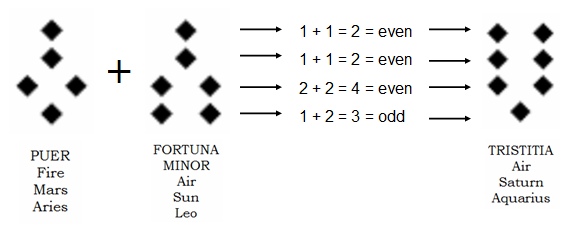
To combine figures, choose one known figure for each GD you wish to invest. To combine them, look at the first line of two figures. If they are the same, the resulting figure has two dots in the first line, otherwise it has one. Repeat this process for each of the following three lines. Using the resulting figure, do the same for any remaining figures. Compare your result to the list of figures and use the corresponding one.

Roll all invested GD. Doubles cause Mishaps - minor problems as the figures' power takes its toll on you. Roll on the Mishap table. Triples draw the eyes of the judge Chare, causing Dooms. Immediately suffer the next entry on the Doom table.

When you gain Template A, roll 1d6 twice and gain the listed Figures. Template B, roll 1d8. Template C, roll 1d10. Template D, roll 1d12 4 times. If you roll a Figure you already have, roll again.

Talismans: You may cast Figures from Geomantic Talismans, which have been made by geomancers past. When using a Talisman, invest any number of GD without combining Figures, then invest another temporary GD. The Talisman is then destroyed.

Watchful Eyes: The influence of the Watchers have changed your very senses. You can tell at a glance whether or not magic is at play, and may learn more specifics by testing Mens. You can tell by looking at someone whether or not they have been touched by the Watchers. This is not knowledge meant for mortal minds. Immediately and permanently lose 1 Mens.

Figures

1. Cauda Draconis
R: Touch T: Creature D: Instant
The Tail of the Dragon. Represents endings, completions, disruption, and loss. Deal {sum} damage to target; they make an Animus save with a {dice} penalty or suffer a Minor Injury. If 4 or more Dice are invested, they suffer a Major Injury on a failure instead.

2. Conjunctio
R: N/A T: A random Watcher of {sum} HD or less D: {sum} minutes
Conjunction. Represents interaction, contact, and union. Allows you to speak to a random Watcher. If you speak a Watcher's True Name (which is not the name they are known by), you have a 1-in-4 chance of speaking with that specific one instead.

3. Albus
R: 30' T: Creature D: Instantaneous
White. Represents peace and detachment, intellect and transcendence. All emotional effects of the target (fear, anger, sadness, pleasure, pain) end. Emotions slowly return in {sum} minutes, but subdued. You can target yourself. If this targets an unwilling creature, they may make an Animus save to resist this effect, adding {dice} to the result.

4. Puella
R: Sight T: {sum} creatures D: {dice} minutes
The Girl. Represents harmony, balance, and love. Up to {sum} creatures that can see you make an Animus Save (with penalty equal to {dice}) or is compelled to approach you. If they are hostile, they will approach you with hostile intent.

5. Laetitia
R: Self T: Self D: {sum} minutes
Joy. Represents happiness, success, health. Unfavorable when it comes to secrets. You create an area 30’ in diameter, centered on you, in which nothing can knowingly lie. Unwilling creatures may make a Mens Save to ignore this effect, with a penalty of {dice}.

6. Tristitia
R: Touch T: Area D: {dice} hours
Sorrow. Represents despair, illness, and failure. A pit {sum}’ deep and 10’ in diameter appears at the point you touch. The sides are smooth and difficult to climb. Anything in the pit when the duration expires is summarily disgorged.

7. Via
R: N/A T: Self D: Instantaneous
The Way. Represents change, movement, and journeys. Teleport {sum} x 5' in the direction you are facing. If you cast this spell while moving, make a Corpus Save to avoid falling prone.

8. Carcer
R: 50' T: Creature D: concentration, up to {sum} rounds
The Prison. Represents isolation, restriction, delay, and binding. Target creature is locked in place. While concentrating, you may move, but may not take any other actions. Target can breathe and move their eyes, but cannot swim, fly, or perform any other action. If the creature is particularly willful, blasphemous, or a spellcaster, it may make an Animus save each round to break free, with a penalty equal to {dice}.

9. Fortuna Minor
R: Touch T: Creature D: {dice} rounds
Lesser Fortune. Represents swiftness, inconstancy, and generosity. Target moves twice as fast for the duration. If at least 3 dice are invested, they can take any extra action each round instead, ignoring rules about action count.

10. Populus
R: 50' T: {sum} creatures D: {dice} minutes
The People. Represents stability, dispersal, and multiplicity. For the duration, targets cannot form any new short-term memories. They are always surprised and will forget anything they have seen the moment it goes out of sight.

11. Puer
R: Touch T: A non-magical weapon D: {Dice} hours
The boy. Represents war, energy, and direction. The affected weapon gains a bonus of {dice} to hit and becomes magical for the duration. The next time it would damage a target, deal an additional {sum} damage and the effect ends.

12. Caput Draconis
R: Touch T: Surface D: {dice} hours
The Head of the Dragon. Represents beginnings, opportunities, and new possibility. The opening of doors. A passage forms in the touched surface. The passage is large enough for a single file line of standard humans and goes up to {sum} feet into the surface. When the duration ends, the passage closes, dealing {sum} damage to creatures inside before ejecting them to the nearest unoccupied space.

13. Acquisitio
R: 100' T: Area D: Instant
Gain. Represents success, profit, and prudence. Buried or covered objects rise to the surface in area you designate, {dice}x10' in radius. If you cast this spell on the ground, coins, stones, and root will be pulled to the surface. If you cast it on water, sunken objects will rise to the surface and remain there until you take damage or another action. The total weight of dredged objects cannot exceed {dice}x100lbs.

14. Amissio
R: 30' T: One creature or object D: Instantaneous
Loss. Represents transience, loss, and generosity. Target turns to dust. Creatures with more than {sum} hit points are immune. An apple-sized object can be disintegrated with 1 die; cat-sized with 2 dice; human-sized with 3; and so on, proportionately.

15. Fortuna Major
R: 50' T: Creature D: {sum} rounds
Greater Fortune. Represents inner strength, power, and success. For the duration, if the affected creature would fail a roll, they succeed instead. After {dice} times, end the effect.

16. Rubeus
R: Touch T: Creature D: {sum} days
Red. Represents passion, worldliness, pleasure, and violence. Target makes an Animus Save. On a failure, for the duration, nothing seems like a bad idea to the target, any whim is indulged to recklessness. From an ordinary commoner, expect profligate violence, adultery, gluttony and embarrassment when the duration elapses. Against mercenaries, wizards and nobility, anything goes. If you possess hair, blood etc. of the target, range is 100ft. Spellcasters may attempt an Mens Save each day to end the effect early.

Geomancy Oracle - PsychicScience.org

Geomantic Figures 

image4.png 

Example of Combining Figures 

Mishaps

  1. GD only return to your pool on a 1-2 for 24 hours.
  2. Take 1d6 damage to your Mercy.
  3. Random mutation for 1d6 rounds, then Save Corpus. Permanent if you fail.
  4. Gain 1d6 Stress.
  5. For 1d6 rounds, you are struck with the Fear of Chare. Flee as deep underground as you can until this effect ends.
  6. Cannot use Figures for 1d6 hours.

Dooms

  1. The Eyes of Chare cause the Watchers to flee from you. You cannot use Figures for 1 day.
  2. The Eyes of Chare follow you. Any person of a Holy Calling knows of your calling by looking at you.
  3. Chare catches up with you. Chains erupt from the earth and pull you to the Pit where the Watchers are bound.

"The Sons of God Saw the Daughters of Men That They Were Fair" by Daniel Chester Finch (1923)
 
While the Nephilim are most feared of those cavorting with Watchers, and while such fear is justified, kings fear the Geomancers even more. A random citizen is likely to survive meeting one of these enigmatic sorcerers (though they may not remember it), but those who work with the signs of the earth have toppled nations. Any king worth his crown has equipped his courts greatly to prevent Geomancers from entering his halls.
 
Luckily for most rulers, the Geomancers themselves are rarely prone to overthrowing entire kingdoms. Like their brethren the Nephilim, many find themselves drawn into the Wastelands in search of their masters. Most who remain in the civilized lands find themselves on the wrong end of an executioners blade long before mastering the most powerful of figures.
 
 
Okay I've never made a spellcaster and, while I've historically enjoyed playing them, designing them is so so hard forever. Looks at the time between posts. Would it have been prudent to run this by someone before posting? Maybe someone who knows how this works? Probably but consider these words of an ancient master: posting is fun. 

Sunday, February 15, 2026

Genesis 6:4 (GLoG Class: Nephilim)

And the Light said to Mihel, "Go, bind Samlazaz and his associates. And when their sons have slain one another, and they have seen the destruction of their beloveds, bind them fast for seventy generations in the valleys of the earth, till the day of judgement. In those days they shall be led off to the abyss of fire. And whosoever shall be condemned and destroyed will from thenceforth be bound together with them to the end of all generations. and destroy all the spirits of the reprobate and the children of the Watchers."

- Chare 4:13-14

In the ancient days, it was not Candor who gave us the means to fill our stomachs. Only the Watchers came to aid us. It was through them that we learned to fashion the blade. You use their gifts even now, Should we not follow those who gave us life? We walk in the footprints of giants - should we not aspire to be the same?

- Octavia the Giantess, before her beheading, AT 374


undefined 

"Saturn Devouring His Son" by Francisco Goya (c. 1820) 

Many Callings exist in the world below. Some are those of the laypeople, like the Shepherds or Alchemists. Still others are holy, such as the Hieromonks or Exorcists. This is not one of those callings. Some have always chosen to cavort with the Adversary, though their numbers have only seemed to grow in the time since the Second Fall. Perhaps the most feared of these forbidden callings are the Nephilim, who have bound themselves to the fallen of Heaven. The call of the Watchers is stronger, down in the earth. It was inevitable that some would give in. They grow, they terrify, but most importantly: they hunger.


 Undefined

"Die Menschenfresserin" by Leonhard Kern (c. 1640)

(A brief note on relevant terms: Corpus is equivalent to Meat in BONES.)

Nephilim

Starting Equipment: Broadaxe (heavy), three rations of dried meat, 5 ft. of chains

Starting Skill: Butchery

A: Forbidden Calling, Gift of the Watchers, Gluttony

B: Terror of the Giants

C: Hefted Blades

D: As the Sons

You gain 6 inches of height for each template of Nephilim you have.

Forbidden Calling: This calling involves actions that are illegal, in the eyes of the church and the law alike. If your true skillset becomes known, you may be arrested and tried.

Gift of the Watchers: The Watchers have opened your very being to new possibilities. Gain a new Virtue - Orexis. Roll 2d4 for it's initial value. Test Orexis to consume something inedible. Save Orexis to hold your stomach. As an inventory, Orexis stores items you've eaten. When you consume something, add it to your Orexis. At the end of a rest, destroy all stored items. You may expend a number of Orexis slots equal to your templates of Nephilim in order to do one of the following:

Frenzy: After making an attack, make {slots}/2 extra attacks, rounded up.

Fortitude: After making a save, reroll. Subtract {slots} from the roll.

Fear: After killing an enemy, force its allies to check Morale. Add {slots} to the roll.

Gluttony: It's never enough. At the beginning of every rest, make an Orexis save. Subtract one for each filled slot. If you fail, gain Fatigue equal to your templates of Nephilim.

Terror of the Giants: Your presence inspires fear. You automatically succeed when attempting to intimidate those shorter than you. Some creatures, such as Kings, demons, or hardened veterans, may save with disadvantage.

Hefted Blades: You tower above others, most weapons dwarfed by your powerful build. You may use heavy weapons one-handed.

As the Sons: Like your ancient namesakes, the flesh of man makes you even stronger. For each slot of your Orexis filled with human flesh, gain 1 temporary Corpus. A human being, if prepared correctly, produces rations equal to their Corpus. 


undefined 

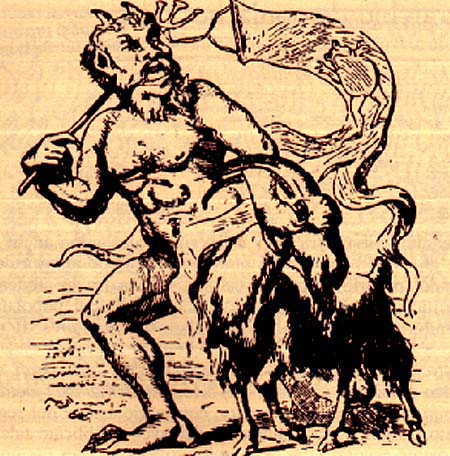
"Azazel" from Dictionnaire Infernal, Collin de Plancy (1863)

Who are the Watchers, that mortals would ally themselves with them? The Watchers were angels, once. In the time before the first flood, they fell in love with mortal women. Turning against Candor, they taught mankind all manner of wickedness - the crafting of blades, the workings of magic. Chare, the chosen of Candor, came to judge them and their children, the first Nephilim. They were bound in the bowels of the earth until the end of days.

As long as mankind has roamed the earth, there have been those who succumb to the call of the Watchers. It is said that they appear in dreams. It has also been said that their first children, the Nephilim from which these hungry souls take their name, still wander the earth as spirits. Some claim that these modern Nephilim have been possessed by the souls of their namesakes, though there is no writings on an exorcist successfully exorcising one.

In the years since the Second Fall, the call of the Watchers has grown ever stronger. In cities, in villages, there are always whispers of those who grow beyond belief, who hunger for the unholy. While certainly illegal, texts abound about how to call upon their aid.

Often times, those bound to the Watchers will leave the civilized lands, venturing out into the Wastelands. Some say they are searching for the pit the Watchers are bound in, though if any have done so, they haven't returned to tell the tale.


As more of a design/stylistic note, the Watchers will serve as the archetypal deal-offering devils. They offer forbidden knowledge, knowledge that can grant power, but that will come with a cost one day. Most of the Forbidden Callings will connect to them by some means. The Watchers, while certainly against Candor, may or may not be aligned with the Adversary and his demons. Finding them or the pit could certainly be an excellent campaign idea if you wanted!

This class was weird to make. It went through a lot of iterations, from more of a summoner type to a spellblade to the current fighter-barbarian-hungry-guys. I'm pretty happy with the concept now though - utilizing the stats as inventory feature feels particularly fun for this. Numbers are certainly subject to change, cause I have roughly 0 idea of how balanced this is, but I like it for now. 

Now that I'm up to 3 finished classes for Anno Tenebris, I'm starting to think more about a conceptual playgroup and realize that I've basically made 3 fighter types and exactly 0 specialists or magic users. Now I have to decide whether I make the fourth planned fighter type or jump into some of the specialists or magic users. But that's a question for later!

Wednesday, January 28, 2026

Silence in Molaris Cuspia - An Anno Tenebris Starter B⬡X

Not sure if it counts as a bandwagon, but Primeumaton of Madman's Menagerie fame has offered a challenge: over the course of 2026, create a starter set for your setting/system (settstem? systing?). You can find that challenge here, but really it's pretty much what it says on the tin. As such, I figure I should make some meaningful work to get Anno Tenebris to a runnable state - and hey, with two classes down, I figure it's pretty doable! Right? Anyway, this is the start of that.

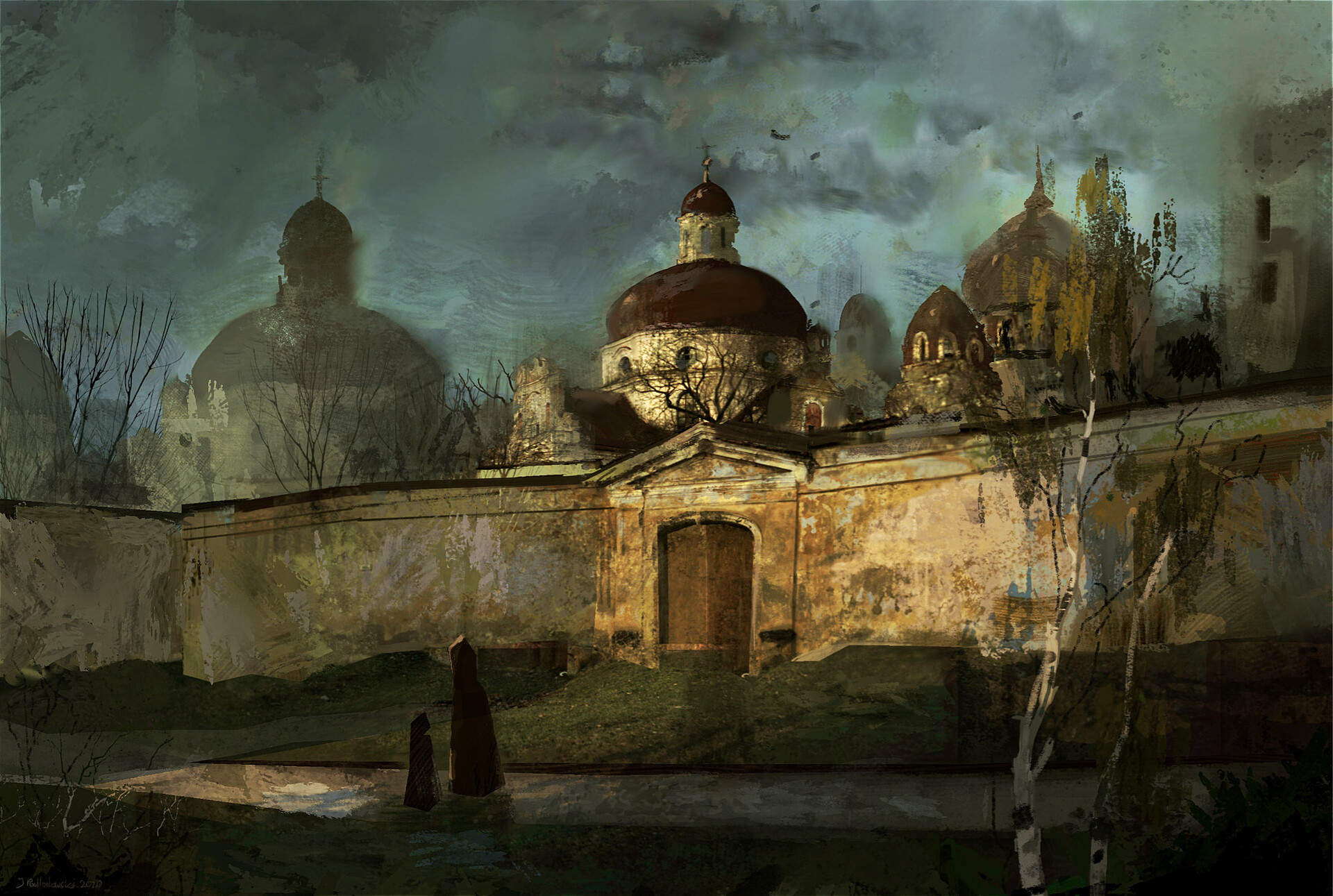
 Abandoned Monastery in Vilnius

"Abandoned Monastery in Vilnius" by Jakub Podlodowski (2020) link

Silence in Molaris Cuspia


"Ora Hexcrawl" by Me (2026) 


The town of Ora is a last beacon of civilization before the Wastelands to the east, on the edge of Sepulchre. First founded nearly 200 years ago, it lies on the edge of the Tiferus River that once supplied the town with much needed trade. With a population of about 500 spread over a few miles, they represent the Light of Candor staking claim in the darkness. That Light is dimming.
 

Five years ago, the nearby Molaris Cuspia (C2), a monastery of the Olean order, went silent. No longer do they tend the olives or press oil, no more do their hieromonks and exorcists aid the surrounding towns. The townsfolk who entered the monastery have not returned. The Bishop Pinarius has hired Fossors to find the truth, root out the evil in the Molaris, and, most importantly, recover the Most Blessed Veil of Saint Tifernia, who carried the holy saplings of olive to the lands below during the Second Fall. Those who do so and return to the Holy See will be offered a payment of 1000 numma, as well as the favor of the Episcopacy. 
 

Three years ago, the citizens of Ora (B1) were offered an alternative. A woman by the name of Elda came to the town, proclaiming Ora to be home to a great site of Tenebra. She has founded a small church, centered around a great pit (A2), though it has begun to grow in numbers. The citizens of Ora cling to what they can. Though the northern mill (A1) has continued to thrive, the local parish (A1) has suffered. After the fall of the Molaris, the rise of Tenebrism has not helped Ora's reputation of harboring wickedness. To date, the Church has had bigger issues, but as always, the King Modestus offers a 10 numma bounty for each heretic brought back to Lucerna in chains.

Demon attacks are always common in unprotected town, but one year ago, things took a dramatic turn for the worse. Attacks have only been increasing in prevalence, and the town whispers of a Diabolist haunting the Wastelands near the Molaris (B3). To make matters worse, the harvest from the beet fields (B2) has been poor this year. The town is starving. For reasons unknown, the graveyard (C1) outside of town has been spared from demonic presence, though rumors abound about how. The Mayor Ardito of the town has put out a bounty offering 40 numma for any who can find the source of their misery and stamp it out.


The above information is all player-facing. This is the point where the example hexcrawl went in depth to each hex and gave you stat blocks. I'm not doing that right now, in part because I have to finish some rules things but mostly because it's 2:45 AM and I'd rather go cuddle with my boyfriend. Anyway I'll probably change parts of this over the next 11 months but this is where I'm starting. Thanks for reading xoxo. Also P.S. to Primeumaton cool challenge and I look forward to being boiled by your lawyers.

Sunday, January 25, 2026

Matthew 4:4 (GLoG Class: Hieromonk)

 Thus I say to you: Did the Way not know and fulfill the Scriptures? For just as He rebuked evil, He told his disciples to rebuke it in the name of Candor. The Adversary knows the Scriptures, but you must know them in full so that you may rebuke him. Remain vigilant, brothers and sisters, for knowing the words of the Way shall protect you against all things.

- St. Lucian of Andagis, 147 AT

And so the Way said, "It shall be said to those which memorize the Scriptures, 'Recite, and be bathed in light.' For those that are holy should come to no harm, for they wield the light in the name of my Father. Therefore go and know the Scriptures, that you may cast out demons in my name. Those who hold my teachings in their heart always shall walk in the light of Candor all of their days." After doing such things, all the Way said came to pass.

-Revelation of Marcellus 4:21-25

Monastic life has only grown in prevalence in the time since the Second Fall. Monasteries and Nunneries can be found in cities and towns, as well as dotting the roads between settlements - beacons of light in the darkness for those brave enough to risk traveling between bastions of civilization. Most of the cloistered monastics here are the typical sort: quiet, unassuming, and devout. But a select few of these have truly dedicated themself to the study of the Scriptures, and have been able to harness their unique powers against all manner of evils. These are the Hieromonks*: forced to leave their cloisters in order to properly utilize the gifts Candor has given them. The Church and nobility alike have utilized these gifts in expeditions into the deep dark. Most of them go willingly.

Exorcism - Not Even Past 

Painting from Shrine at Mariazell, Artist Unknown (1512)

(A brief note on relevant terms: Mens is equivalent to Head in BONES. Vigour is analogous to Hit Points, Mercy is analogous to Ego, and Sanity is analogous to Sanity in the same).

Hieromonk

Starting Equipment: monk's robes, abridged book of scriptures, journal, ink + quill

Starting Skill: Religion. Also, roll on the monk table from MROS.

A: Monastic Vows, Literacy, Holy Light

B: Hegumen, Unyielding Memory

C: Archimandrite, Divine Guidance

D: Light of the Scriptures

Monastic Vows: All Hieromonks take the vows of monastic life. You are not permitted to use weapons of any kind. You are expected to follow the virtues of chastity, poverty, and obedience. Make up an additional 2 restrictions of your community. 

Literacy: Unlike most, you are capable of reading and writing exceedingly well. Your letters allow you to make Mens checks at a distance. You may understand the themes of literature, holes or inconsistencies in a contract, and can follow the works of great thinkers. 

Holy Light: You have a pool of Light Dice (LD) equal to your templates in this class. These are d6s and represent the divine power that you channel in pursuit of your priestly duties. When rolled, they return to your pool on a result of 1-3, and deplete on a result of 4+. Once per turn, you may invest any number of LD to take the following actions:

Rebuke Them: Your touch burns the unholy. Touch up to {dice} targets in arm's reach to deal {sum} total damage, divided as you please amongst them. You may choose to direct this damage to Vigour or Mercy. This may only be used against demons, undead, or those who have cast their lot in with them - the Light of Candor will spare the worthy.

Peace: The Light calms you. Remove {dice} stress and regain {sum} Sanity.

Holy Sight: You sense the presence of demons, the undead, and the possessed within {dice} * 20 feet for {sum} rounds.

By spending at least an hour reciting your memorized scriptures, you may restore all of your expended LD. If you break any of your Monastic Vows while you have at least 1 LD, invest all available LD and take {sum} damage to your Mercy. Deplete LD as normal. You may release your pool of LD as an action.

Hegumen: The Scriptures reveal deeper wisdoms to you than most. You may sense the presence of hidden passages and creatures within 60 feet during your recitations. 

Archimandrite: You may learn the direction to an object of your choice during your recitations.

Unyielding Memory: The skills you have honed memorizing the scriptures continues to serve you. You have a perfect recall of everything you have read since gaining this ability.

Divine Guidance: Your knowledge of the Scriptures guides you. Once per rest, you may declare an attack that hits you misses instead.

Light of the Scriptures: The light of the Scriptures has illuminated you. Your eyes glow with a light as a torch. While blindfolded, you still 'see' with a radius of 40 feet. When you speak on holy matters, people are compelled to listen. You may invest LD twice in one turn. 


* A note on gender and the Church: Hieromonks arise out of monasteries and nunneries alike. However, the Scriptures only speak of men as miracle workers**. The Church itself holds doctrines that only men can administer the rites of salvation. The Hieromonks, as enactors of holy grace, must be able to enact the Sacraments. Therefore, the presence of divine power implies that one is a man. Nuns who demonstrate the power of the Hieromonks will change their names and will live life as men. In the rare event that they do return to cloistered life, they will return to a monastery of their Ordo.


** A note on the Scriptures: The astute and well read among you may be aware of prophetesses and other women bearing power. The Church has much to say on this matter, but still contends that the priesthood, and all the powers conferred upon it, are only for men. Smaller settlements, further from the religious centers like Calidae, may have Hieromonks who still present as women, but this is unorthodox and strictly forbidden by the Church. 

Monday, January 12, 2026

Working Title: Everything is Meat

I could keep working on the Anno class I'm writing up but I got to thinking about dwarves and now I'm here. Blame my dad playing Dwarf Fortress while I was visiting. I've been reading about animals a lot lately and got to thinking about just how wild life is. Like there are so many crazy things going on. So I've ended up with a little list of how these insane biological organisms could look like an elf game. This could be a really fun setting to fuck around with. While being less magical than the world where Demons Are Real And Can Kill You, it's been scratching the 'classic fantasy' itch really well. So I guess this is a Dwarf Post™.

What Is A Dwarf?

A Dwarf is a mammalian sapient, known by many names depending on an individual Dwarf's designation. The species gets its name from the worker members of the hall, named due to their relative diminutive statue. Warrior members are known as trolls. There are no documented cases of non-Dwarves meeting a king, but they appear to be the only breeding member in a given hall of Dwarves.

Types of Dwarf

Most Dwarves are work dwarves (Note: in this text, as most other texts, the uppercase Dwarf is used to refer to the species, while the lowercase dwarf is used to refer to the worker category). They are generally 4-5 feet tall, broad shouldered, and are easily identified by their large beards. These beards are sensitive to vibrations in the air, and aid the dwarf's hearing. Most dwarves remain in the hall, mining, brewing sustenance for members of the hall, or caring for young. When a hall gets large enough, some dwarves are sent to find suitable locations for a new hall - these dwarves will return and bring a king to a location once found. These dwarves are common adventurers.

Warrior members of the hall are known as trolls by most. They stand 8 feet tall or more, and possess large, horned fists they use in defense of the hall. They have different skin patterns than work dwarves, generally having a mottled complexion akin to the stone most dominant in the hall. Their beards are worn in different styles, generally combed straight rather than braided. These Dwarves are rarely seen outside of the halls, though occasionally a new king is escorted by several trolls in addition to the scout dwarves.

In most strains, this leaves the king, a mysterious figure in the hall. While there are no recorded instances of a non-Dwarf meeting a King, several things are known: he is fertile, unlike most of the members of the hall, and spends the majority of his time rearing young. The diversity of Dwarves implies the existence of a second fertile category, though adventuring dwarves are generally unwilling to discuss it. 

Some strains of Dwarf diversify their workers. These halls will have dwarves as normal, but may also have some builder class members, known as gnomes. These Dwarves will lack the beard of their worker and warrior counterparts, generally possessing more manual dexterity for finer tasks. This is theorized to be a recent development in Dwarven history, as very few strains possess these members. As with most species, there is a great diversity that has yet to be properly studied.

Dwarven Habitat

Most Dwarf halls are in mountainous or otherwise rocky regions, given the Dwarves biological instinct to tunnel into the earth. When space is particularly limited, members of a new hall will dig downward, through the soil until they reach a rocky layer where a proper hall can be constructed. Certain strains of Dwarf are known to prefer certain rock types, an abundance of certain precious metals, or the presence of certain gemstones. It is unclear by what mechanism a dwarf can sense these traits, but most scout dwarves are able to determine a locations viability after only an hour of mining. Most Dwarves are known to be averse to large bodies of water, but there have been documented halls along ocean cliffs or, more rarely, halls that open up into lakes or bays.

Dwarven Diet

Dwarves are known for their enjoyment of fermented food and drink, particularly alcohol. The reason for this is theorized to be twofold. First, fermented foods will generally last longer than their raw counterparts, leading to longevity for the hall's food stores. Additionally, most strains of Dwarf have limited digestive microbiomes, relying on a constant supply of microbes from food. As such, the cultivation of food-safe bacteria and fungi is an important part of Dwarven life. Most strains of Dwarf subsist entirely on ferments, with some noteworthy strains seeming to consume only alcohols.

Monday, December 1, 2025

John 10:11 (GLoG Class: Shepherd)

And the Teacher said, "The Shepherd knows his flock, even if they do not know him. They listen to his call and heed him, for he lays his life down for them. He gives them life unending and once again picks up his life. For did not the shepherd slay giants? They will know my shepherd by my signs, as they know me by my Father's signs. They shall not know the kiss of death, for I have overcome death."

-Apocryphon of Lazarus

The Church has long compared its members to sheep. Few take the message to heart as deeply as the Shepherds. While not strictly a Holy Calling, Shepherds are those who dedicate themselves to protecting the flock. As such, they are greatly valued in the deep dark. Most Ordines have formal organizations of Shepherds, but any who take up a sword in defense of their neighbors may be a Shepherd. Infused with the sheer power of faith, they are a light in the darkness.

Parable of the Good Shepherd, Philips Galle (Netherlandish, Haarlem 1537–1612 Antwerp), Engraving 

"Parable of the Good Shepherd" by Philips Galle (1565)

Shepherd

Starting Equipment: leather armor, sword (medium weapon), shepherd's crook

Starting Skill: Herding

A: Lay Down Your Life, For The Flock

B: Heed The Shepherd

C: Lay Giants Low

D: Take It Up Again 

You gain +1 Vigour for each template of Shepherd you have.

Lay Down Your Life: As the shepherd, you put yourself in harm's way for the sake of others. When you take damage, you gain an equal amount of Grace. Grace can be spent to add to opponent attack rolls or subtract from your own saves. 

For The Flock: The good shepherd protects the flock from harm. You may intercept an attack meant for another character within your movement range. Move to the square that character occupied, move them one square in any direction that makes sense, and take the attack as if you were the original target.

Heed The Shepherd: Your presence inspires peace and trust in members of the flock. You gain advantage on Animus checks against commoners.

Lay Giants Low: The strength of your Grace stuns those who would harm your flock. When you use your For The Flock ability, you may spend any amount of Grace. The attacking creatures makes an Animus save against this effect, adding the amount of Grace you spent. If they fail, they are stunned for a number of rounds equal to (Grace/their HD) rounded up.

Take It Up Again: The Grace of Candor sustains you, even in spite of grievous harm. When you would die, instead spend all your Grace and regain 1 Vigour. All Undead within Grace * 5 feet are destroyed. All Demons in the same region are banished and all Tenebrous creatures are turned. Lose all templates you have in Shepherd.


 NOTES

I've never made a class before but I think this works! Big shout-out to Blatt of MASCARA KNIGHT fame for advice on GLOG, OSR, and general design (as well as the ability from ze's Gallant, which I aped for the ability For The Flock). A lot of the other abilities are inspired by the Angel-blooded Resonator by Gil on the Phlox Discord server! 


Monday, September 15, 2025

Anno Tenebris - Ordines (And some other lore/rules tidbits)

Let no sin go unwitnessed, nor unconfessed. We beneath this earth may offer no absolution - only Candor is worthy of such grace - but through your witness and confession strive for holiness. For as it was written in the scriptures, "Thou shalt not bear false witness," as well, "Those things which proceed out of the mouth come forth from the heart; and they defile the man". Keep watch over your brothers and sisters, and if your brother should not confess his sins, confess them to Candor on his behalf."

-St. Vigilus, in his letter to Salona (43 AT)

And Wisdom said, "The names given to the worldly are deceptive, turning the heart from what is good to what is evil. So also with 'The Light' - it does not lead one to what is good but to what is evil. How pitiful are those that listen to the names of the worldly! Yet it is Tenebra who brought names into the world, for we cannot learn it without these names. There is only one truth, but it has many things to teach us."

-Phillipus, in his Gospel 

The lands of Sepulchre lay beneath the world that was. In this place, the color of ones' skin holds no bearing over their allegiances. While kings reign under the earth, citizens' allegiances do not truly lie with them. Instead, the most significant aspect of one's identity is their Ordo (pl. Ordines) - their order of faith. When creating a character in Anno Tenebris, an Ordo must be selected. Many Ordines exist in Sepulchre, and each vary in many ways, but they can be split into roughly two broader schools of thought: Candescent and Tenebrous.

https://upload.wikimedia.org/wikipedia/commons/thumb/3/3f/Jean_II_Restout_-_Pentecost_-_WGA19318.jpg/330px-Jean_II_Restout_-_Pentecost_-_WGA19318.jpg 

"The Pentecost" by Jean Restout II (1732) 

The Candescent Ordines are the only Ordines permitted in most lands. Each is part of the 'Universal Church', sharing their common head in the Supreme Pontiff, but few would identify themselves as such. The Candescent Ordines refer to the Godhead as 'Candor', first and foremost viewing light and flame as holy. Most Ordines fall under this classification; several are listed below:

Domae: Derived from the pre-Fall practices of the lands above, the Domae maintain that only proper observance of the old ways will lead to humanity's return to the surface. Due to their strict observance of the surface faith, they maintain the ability to transubstantiate.

Vigilan: The Vigilan tradition stems from the writings of St. Vigilus, a wandering ascetic who held that only witnessing and confessing would result in forgiveness from Candor. Their Ordo is centered around the shrine at Calidae, where St. Vigilus' journey ended in his death.

Cares: The Cares are, in most cases, a quiet and meek Ordo. They maintain a strict schedule of fasting and prayer -  a schedule which many find altogether too rigorous. Even so, they hold that greed and material desires led to the Second Fall, and only the rejection of such desires will herald their redemption. 

Jusepe de Ribera - 101 artwork - painting

"Mater Dolorosa" by Jusepe de Ribera (1638) 

A much more recent development, the Tenebrous Ordines are denounced as heresy by the Supreme Pontiff and as such illegal in much of Sepulchre. According to the Tenebrous Ordines, when fire rained down from above, it was the darkness that offered them succor. Thus, the Divine is present not in light, but in darkness. This has resulted in an altogether very different theology, where the Divine (known to them as Tenebra) resides not above the earth, but far below. They reject many of the modern scriptural texts such as the book of Eskhat, which details the divine process leading to the Second Fall. Due to their strict illegality, there are fewer Tenebrous Ordines large enough to speak of.

Tenebrae: The first and largest of the Tenebrous Ordines, the Tenebrae maintain that the Second Fall is a way of bringing them closer to Tenebra, as well as offer a test. Only the most faithful in this time of trial will journey deeper into the earth to approach the divine throne. Altogether a more dour and mystical group than the mainstream Candescent Ordines.

This list is far from exhaustive, and when I get to some more proper rules balancing I'll be able to make something a little more concrete as far as the rules implications of each Ordo. It's also worth noting that not all characters need be priests or others dedicated to religious life (though it's certainly useful to have at least one in a group). Even so, the tenets of the Ordines dominate life under the earth, and thus one's Ordo has a great effect.

undefined 

"Engraving of Marcella of Rome" by Diodore Rahoult (1886) 

However! Beyond that it's probably good for me to get some concrete rules put together for Anno Tenebris (GLOG Hack Edition). Like I said in the last post, BONES by The Oblidisideryptch is a good starting point. First up: Stats!

Much like the source here, we have 3 primary statistics, each of which is determined by the number of slots available within it. Unlike the source, I am changing the names of them in order to fit more with the broader feel of the setting. The 3 primary statistics are as follows: Corpus (C, analogous to BONES' Meat), Mens (M, analogous to BONES' Head), and Animus (A, analogous to BONES' Soul).

Personally I find the d20 roll under system a little unintuitive, but every attempt to find something better has run into walls. I considered Fabula Ultima's increasing dice size as an option, but this added complications to the inventory system and resulted in way too many charts. I also considered the PbtA system of no values, only modifiers, but that basically eliminated the inventory I liked so much. So we're going to keep it. 

Character creation is basically 3 steps: Rolling for stats (see BONES' 2d4 per stat), rolling for Ordine (table forthcoming once I have more concrete rules), and rolling for initial template (templates forthcoming). Until then, there are several things I want to get onto paper (or. . .digital paper). 

Some archetypes I want to hit with templates include: The Holy Person (feels a bit obvious, also there will likely be a lot of these), The Soldier (a classic for a reason), The Dungeon Specialist (dungeons will almost certainly be getting their own post - for now though just know that they are plentiful and dangerous), Alchemists (did I mention there's alchemy?), and The Spellcaster (see above. Needless to say, it's complicated and requires consorting with Otherworldly Creatures). There will almost certainly be more, but those are some initial concepts that definitely need to be included.

Also, some more concrete and less vibes-based setting lore. Like I said in the last post, the world 'ended' in 500 AD. The mechanics are unclear, maybe it was natural, maybe wasn't, but at that time the sunlight was brighter and hotter than ever before. It burned the people, it set fires, it ended civilizations.

the sun is a deadly laser Blank Template - Imgflip 

"history of the entire world, i guess" by bill wurtz (2017)

The lands of Sepulchre lie predominantly under what would be Italy in the modern day. Just pretend there's a huge, underdark-like network of caverns underneath the world. There are still oceans, of a sorts, but life is carved out in small beacons of light in these massive caverns. Being in the dark and with limited ways in/out of any given cavern, trade and information networks are much smaller than they once were. 

Beyond the lights of small settlements, there are plenty of failed towns - ruins of the many who survived the initial Fall, but could not persist against the horrors contained in these caverns. Demons roam in the darkness, preying on the weak-willed and weak-bodied. Whether by possession or merely sharp claws, most who encounter them will surely perish.

Modern Gothic Paintings 

"The Last Judgement" by Jan Van Eyck (1436-38)

That's where our adventurers come in. In these ruins are valuable artifacts of the above world - knowledge lost to mankind, holy relics of ages past, and of course, all manner of precious metals. With the increasing role of alchemy, metals in general have become in higher demand than ever before. That goes double for the planetary metals, for while the planets themselves are no longer in sight, their influences are essential. Those who dare to search for these great treasures are known as Fossors, or Grave Diggers.

There are many reasons one may become a Fossor. Most Ordines have them, both from the Holy Orders and the laity, and increasingly nobles have begun to compensate Fossors for their services. Few liege lords will allow just any peasant to leave their lands and delve into the dangerous dark, but many noble houses find it glorious and right for their children to search those ancient ruins. Not the heirs, of course, but an unfavored third son is almost certainly going to have to do his time out in the darkness. 

While most peasants are unlikely to leave the relative safety of their liege's lands, those trained in crafts such as smithing, alchemy, or magic are often given the "opportunity" to become a Fossor, usually escorted by knights or disgruntled scions. Those who survive attain riches and prestige. If you're looking for the way society is stratified, just look at the estates in Many Rats on Sticks by Skerples. Anyway here's some fun art of goetic demon yaaaaay.

undefined 

"Andras" from Dictionnaire Infernal by Jacques Collin de Plancy (1863) 

Jeremiah 10:2 (GLoG Class: Geomancer)

Semjaza taught enchantments and root−cuttings, Armaros the resolving of enchantments, Baraqijal taught astrology, Kokabel the constellations...