Wednesday, January 28, 2026

Silence in Molaris Cuspia - An Anno Tenebris Starter B⬡X

Not sure if it counts as a bandwagon, but Primeumaton of Madman's Menagerie fame has offered a challenge: over the course of 2026, create a starter set for your setting/system (settstem? systing?). You can find that challenge here, but really it's pretty much what it says on the tin. As such, I figure I should make some meaningful work to get Anno Tenebris to a runnable state - and hey, with two classes down, I figure it's pretty doable! Right? Anyway, this is the start of that.
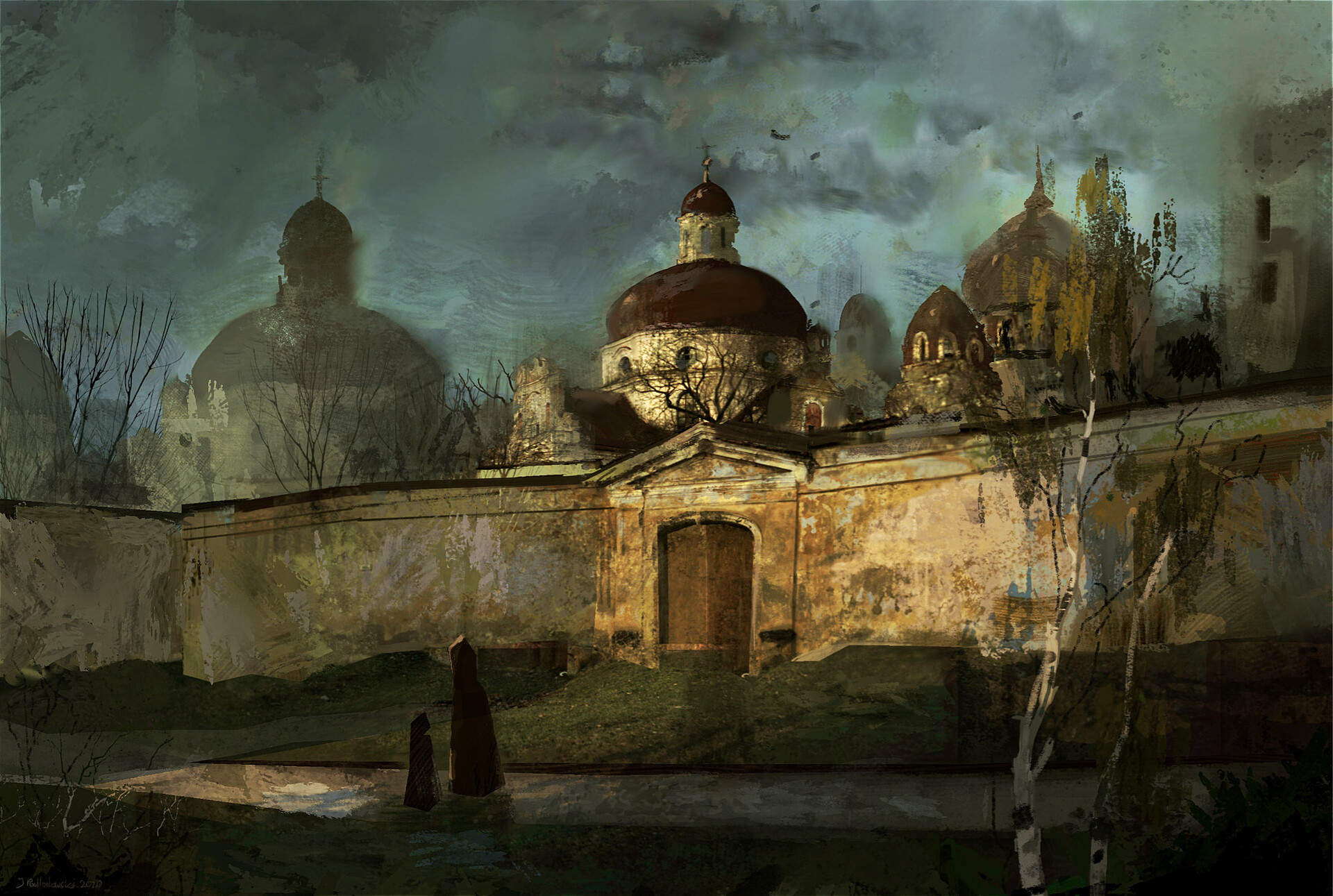
 Abandoned Monastery in Vilnius

"Abandoned Monastery in Vilnius" by Jakub Podlodowski (2020) link

Silence in Molaris Cuspia


"Ora Hexcrawl" by Me (2026) 


The town of Ora is a last beacon of civilization before the Wastelands to the east, on the edge of Sepulchre. First founded nearly 200 years ago, it lies on the edge of the Tiferus River that once supplied the town with much needed trade. With a population of about 500 spread over a few miles, they represent the Light of Candor staking claim in the darkness. That Light is dimming.
 

Five years ago, the nearby Molaris Cuspia (C2), a monastery of the Olean order, went silent. No longer do they tend the olives or press oil, no more do their hieromonks and exorcists aid the surrounding towns. The townsfolk who entered the monastery have not returned. The Bishop Pinarius has hired Fossors to find the truth, root out the evil in the Molaris, and, most importantly, recover the Most Blessed Veil of Saint Tifernia, who carried the holy saplings of olive to the lands below during the Second Fall. Those who do so and return to the Holy See will be offered a payment of 1000 numma, as well as the favor of the Episcopacy. 
 

Three years ago, the citizens of Ora (B1) were offered an alternative. A woman by the name of Elda came to the town, proclaiming Ora to be home to a great site of Tenebra. She has founded a small church, centered around a great pit (A2), though it has begun to grow in numbers. The citizens of Ora cling to what they can. Though the northern mill (A1) has continued to thrive, the local parish (A1) has suffered. After the fall of the Molaris, the rise of Tenebrism has not helped Ora's reputation of harboring wickedness. To date, the Church has had bigger issues, but as always, the King Modestus offers a 10 numma bounty for each heretic brought back to Lucerna in chains.

Demon attacks are always common in unprotected town, but one year ago, things took a dramatic turn for the worse. Attacks have only been increasing in prevalence, and the town whispers of a Diabolist haunting the Wastelands near the Molaris (B3). To make matters worse, the harvest from the beet fields (B2) has been poor this year. The town is starving. For reasons unknown, the graveyard (C1) outside of town has been spared from demonic presence, though rumors abound about how. The Mayor Ardito of the town has put out a bounty offering 40 numma for any who can find the source of their misery and stamp it out.


The above information is all player-facing. This is the point where the example hexcrawl went in depth to each hex and gave you stat blocks. I'm not doing that right now, in part because I have to finish some rules things but mostly because it's 2:45 AM and I'd rather go cuddle with my boyfriend. Anyway I'll probably change parts of this over the next 11 months but this is where I'm starting. Thanks for reading xoxo. Also P.S. to Primeumaton cool challenge and I look forward to being boiled by your lawyers.

Sunday, January 25, 2026

Matthew 4:4 (GLoG Class: Hieromonk)

 Thus I say to you: Did the Way not know and fulfill the Scriptures? For just as He rebuked evil, He told his disciples to rebuke it in the name of Candor. The Adversary knows the Scriptures, but you must know them in full so that you may rebuke him. Remain vigilant, brothers and sisters, for knowing the words of the Way shall protect you against all things.

- St. Lucian of Andagis, 147 AT

And so the Way said, "It shall be said to those which memorize the Scriptures, 'Recite, and be bathed in light.' For those that are holy should come to no harm, for they wield the light in the name of my Father. Therefore go and know the Scriptures, that you may cast out demons in my name. Those who hold my teachings in their heart always shall walk in the light of Candor all of their days." After doing such things, all the Way said came to pass.

-Revelation of Marcellus 4:21-25

Monastic life has only grown in prevalence in the time since the Second Fall. Monasteries and Nunneries can be found in cities and towns, as well as dotting the roads between settlements - beacons of light in the darkness for those brave enough to risk traveling between bastions of civilization. Most of the cloistered monastics here are the typical sort: quiet, unassuming, and devout. But a select few of these have truly dedicated themself to the study of the Scriptures, and have been able to harness their unique powers against all manner of evils. These are the Hieromonks*: forced to leave their cloisters in order to properly utilize the gifts Candor has given them. The Church and nobility alike have utilized these gifts in expeditions into the deep dark. Most of them go willingly.

Exorcism - Not Even Past 

Painting from Shrine at Mariazell, Artist Unknown (1512)

(A brief note on relevant terms: Mens is equivalent to Head in BONES. Vigour is analogous to Hit Points, Mercy is analogous to Ego, and Sanity is analogous to Sanity in the same).

Hieromonk

Starting Equipment: monk's robes, abridged book of scriptures, journal, ink + quill

Starting Skill: Religion. Also, roll on the monk table from MROS.

A: Monastic Vows, Literacy, Holy Light

B: Hegumen, Unyielding Memory

C: Archimandrite, Divine Guidance

D: Light of the Scriptures

Monastic Vows: All Hieromonks take the vows of monastic life. You are not permitted to use weapons of any kind. You are expected to follow the virtues of chastity, poverty, and obedience. Make up an additional 2 restrictions of your community. 

Literacy: Unlike most, you are capable of reading and writing exceedingly well. Your letters allow you to make Mens checks at a distance. You may understand the themes of literature, holes or inconsistencies in a contract, and can follow the works of great thinkers. 

Holy Light: You have a pool of Light Dice (LD) equal to your templates in this class. These are d6s and represent the divine power that you channel in pursuit of your priestly duties. When rolled, they return to your pool on a result of 1-3, and deplete on a result of 4+. Once per turn, you may invest any number of LD to take the following actions:

Rebuke Them: Your touch burns the unholy. Touch up to {dice} targets in arm's reach to deal {sum} total damage, divided as you please amongst them. You may choose to direct this damage to Vigour or Mercy. This may only be used against demons, undead, or those who have cast their lot in with them - the Light of Candor will spare the worthy.

Peace: The Light calms you. Remove {dice} stress and regain {sum} Sanity.

Holy Sight: You sense the presence of demons, the undead, and the possessed within {dice} * 20 feet for {sum} rounds.

By spending at least an hour reciting your memorized scriptures, you may restore all of your expended LD. If you break any of your Monastic Vows while you have at least 1 LD, invest all available LD and take {sum} damage to your Mercy. Deplete LD as normal. You may release your pool of LD as an action.

Hegumen: The Scriptures reveal deeper wisdoms to you than most. You may sense the presence of hidden passages and creatures within 60 feet during your recitations. 

Archimandrite: You may learn the direction to an object of your choice during your recitations.

Unyielding Memory: The skills you have honed memorizing the scriptures continues to serve you. You have a perfect recall of everything you have read since gaining this ability.

Divine Guidance: Your knowledge of the Scriptures guides you. Once per rest, you may declare an attack that hits you misses instead.

Light of the Scriptures: The light of the Scriptures has illuminated you. Your eyes glow with a light as a torch. While blindfolded, you still 'see' with a radius of 40 feet. When you speak on holy matters, people are compelled to listen. You may invest LD twice in one turn. 


* A note on gender and the Church: Hieromonks arise out of monasteries and nunneries alike. However, the Scriptures only speak of men as miracle workers**. The Church itself holds doctrines that only men can administer the rites of salvation. The Hieromonks, as enactors of holy grace, must be able to enact the Sacraments. Therefore, the presence of divine power implies that one is a man. Nuns who demonstrate the power of the Hieromonks will change their names and will live life as men. In the rare event that they do return to cloistered life, they will return to a monastery of their Ordo.


** A note on the Scriptures: The astute and well read among you may be aware of prophetesses and other women bearing power. The Church has much to say on this matter, but still contends that the priesthood, and all the powers conferred upon it, are only for men. Smaller settlements, further from the religious centers like Calidae, may have Hieromonks who still present as women, but this is unorthodox and strictly forbidden by the Church. 

Monday, January 12, 2026

Working Title: Everything is Meat

I could keep working on the Anno class I'm writing up but I got to thinking about dwarves and now I'm here. Blame my dad playing Dwarf Fortress while I was visiting. I've been reading about animals a lot lately and got to thinking about just how wild life is. Like there are so many crazy things going on. So I've ended up with a little list of how these insane biological organisms could look like an elf game. This could be a really fun setting to fuck around with. While being less magical than the world where Demons Are Real And Can Kill You, it's been scratching the 'classic fantasy' itch really well. So I guess this is a Dwarf Post™.

What Is A Dwarf?

A Dwarf is a mammalian sapient, known by many names depending on an individual Dwarf's designation. The species gets its name from the worker members of the hall, named due to their relative diminutive statue. Warrior members are known as trolls. There are no documented cases of non-Dwarves meeting a king, but they appear to be the only breeding member in a given hall of Dwarves.

Types of Dwarf

Most Dwarves are work dwarves (Note: in this text, as most other texts, the uppercase Dwarf is used to refer to the species, while the lowercase dwarf is used to refer to the worker category). They are generally 4-5 feet tall, broad shouldered, and are easily identified by their large beards. These beards are sensitive to vibrations in the air, and aid the dwarf's hearing. Most dwarves remain in the hall, mining, brewing sustenance for members of the hall, or caring for young. When a hall gets large enough, some dwarves are sent to find suitable locations for a new hall - these dwarves will return and bring a king to a location once found. These dwarves are common adventurers.

Warrior members of the hall are known as trolls by most. They stand 8 feet tall or more, and possess large, horned fists they use in defense of the hall. They have different skin patterns than work dwarves, generally having a mottled complexion akin to the stone most dominant in the hall. Their beards are worn in different styles, generally combed straight rather than braided. These Dwarves are rarely seen outside of the halls, though occasionally a new king is escorted by several trolls in addition to the scout dwarves.

In most strains, this leaves the king, a mysterious figure in the hall. While there are no recorded instances of a non-Dwarf meeting a King, several things are known: he is fertile, unlike most of the members of the hall, and spends the majority of his time rearing young. The diversity of Dwarves implies the existence of a second fertile category, though adventuring dwarves are generally unwilling to discuss it. 

Some strains of Dwarf diversify their workers. These halls will have dwarves as normal, but may also have some builder class members, known as gnomes. These Dwarves will lack the beard of their worker and warrior counterparts, generally possessing more manual dexterity for finer tasks. This is theorized to be a recent development in Dwarven history, as very few strains possess these members. As with most species, there is a great diversity that has yet to be properly studied.

Dwarven Habitat

Most Dwarf halls are in mountainous or otherwise rocky regions, given the Dwarves biological instinct to tunnel into the earth. When space is particularly limited, members of a new hall will dig downward, through the soil until they reach a rocky layer where a proper hall can be constructed. Certain strains of Dwarf are known to prefer certain rock types, an abundance of certain precious metals, or the presence of certain gemstones. It is unclear by what mechanism a dwarf can sense these traits, but most scout dwarves are able to determine a locations viability after only an hour of mining. Most Dwarves are known to be averse to large bodies of water, but there have been documented halls along ocean cliffs or, more rarely, halls that open up into lakes or bays.

Dwarven Diet

Dwarves are known for their enjoyment of fermented food and drink, particularly alcohol. The reason for this is theorized to be twofold. First, fermented foods will generally last longer than their raw counterparts, leading to longevity for the hall's food stores. Additionally, most strains of Dwarf have limited digestive microbiomes, relying on a constant supply of microbes from food. As such, the cultivation of food-safe bacteria and fungi is an important part of Dwarven life. Most strains of Dwarf subsist entirely on ferments, with some noteworthy strains seeming to consume only alcohols.

Genesis 6:4 (GLoG Class: Nephilim)

And the Light said to Mihel, "Go, bind Samlazaz and his associates. And when their sons have slain one another, and they have seen the ...